HOA seeks to foreclose on 77-year-old’s home over pressure washing violations
KENNESAW, Ga. (WANF/Gray News) - A Georgia homeowner says he is facing foreclosure after his homeowners’ association has fined him for not pressure washing his home and leaving a bucket of water outside.
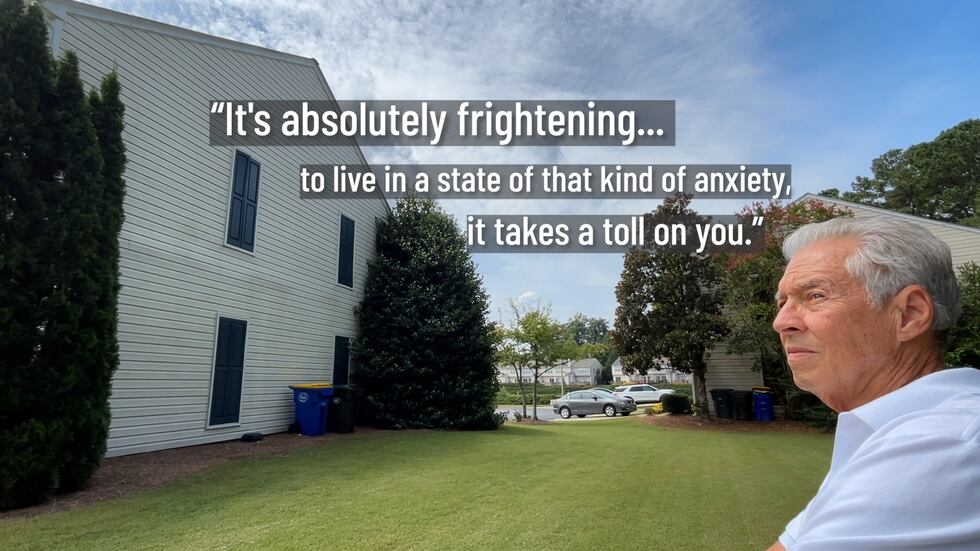
George Watson pointed to the north-facing side of his house, where the off-white wall grew green algae above a small bucket of water and a ladder on the ground three summers ago.
Those items may now cost him his home.
The 77-year-old Kennesaw resident is fighting foreclosure after his HOA accumulated more than $9,000 in fines and legal fees," Watson said, describing his “anxiety, sleeplessness, depression.”
Watson has lived in the Cedarlake Townhome community since it was built in 2001. He now lives on about $20,000 annually from Social Security.
During the pandemic, Watson said he developed a phobia of mail, causing him to avoid checking it for months on end and subsequently missing violation warnings from the HOA.
When Watson finally checked his mail in late 2022, he found a bill from the HOA’s attorney demanding $6,000.
The bill included warnings and fines for failing to pressure wash his house, dump a bucket of water that could breed mosquitoes and remove a ladder.
Watson said he knew the side of his house needed to be pressure-washed due to algae growth, so he borrowed a pressure washer and ladder from his neighbor – both of which he said sat on the side of his house for several months until he got around to it.
According to Watson, he tried to explain and negotiate the costs with the HOA, but it was too late.
In July 2024, the HOA filed for foreclosure after previously placing a lien on Watson’s home. Under Georgia law, HOAs can place liens on homes for any amount and file for foreclosure when the balance exceeds $2,000, a legal action that can be especially frightening for those living on fixed incomes, like Watson.
According to documents, the HOA charged Watson $50 daily for four months from October 2022 to January 2023, totaling more than $1,500 monthly with 7% interest, in addition to regular HOA dues of $180 per month.
Legal costs alone exceeded $3,600 in October 2024.
Watson took out an equity loan on his home to pay for legal representation and has been fighting the case for more than a year.
“I borrowed all the money that’s in the lawsuit,” Watson said, adding he has experienced “a year of anxiety and worry over not having any money.”
MORE HOA COVERAGE FROM ATLANTA NEWS FIRST
The Cedarlake Townhome HOA provides lawn care and maintains a pond, according to Watson, and residents pay HOA dues of $180 a month, a cost that’s been rising by $15 a year.
When Watson bought his home, the development wasn’t fully built, and he chose the property because he wanted a backyard for his son.
“I purchased mine out of a divorce; it was all I could afford,” he said. “Everything I have is tied up in this house, all the equity I’ve got to show for my life.”
Watson said he’s had several disputes with the HOA in the past 20 years, including arguments over lawn care for a larger backyard and the need for more street parking.
Watson is the only homeowner in the community that the HOA has taken to court since 2008, according to records.
Cedarlake Townhomes’ HOA president declined comment, referring questions to the property management company and attorneys.
Tolley Community Management CEO Mike Tolley said the case is in litigation.
“The association has given the owner every possible opportunity, to the best of my knowledge, to resolve the issue before it got this far,” Tolley said. “Someone choosing not to read their mail is not an association issue. The covenants for the neighborhood state that the notice shall be sent by U.S. mail.”
The HOA lawyers with Lazega & Johanson did not respond.
Randy Williams, a metro Atlanta real estate attorney with the Williams Law Group of Georgia, represents both HOAs and homeowners and said laws allowing wage garnishment and liens ensure dues are taken seriously.
“If there were not these sorts of consequences, then people wouldn’t pay,” Williams said.
However, Williams expressed concerns with some motives of board members when it comes to elderly homeowners living on fixed incomes or those battling an illness.
“You want to take their house?” Williams asked. “You probably could, but do you think that’s the human thing to do to a 70- or 80-year-old person?”
“There are some times when you just need to tell your client, ‘Don’t do that,’” he said.
Williams recommended that HOAs consider payment plans for residents on fixed incomes or use “self-help powers” that allow boards to perform repairs or assist directly rather than levy fines and seek legal action.
Many HOAs have these powers stated in their bylaws.
“It would have been cheaper to either knock on his door or move the problem items to the back of his house,” Williams said.
In February, the HOA’s attorney filed for summary judgment seeking nearly $15,000. As of September 2025, Watson was still awaiting the judge’s ruling.
“I’m between a rock and a hard place, and there’s nothing much I can do about it,” Watson said. “What I can do is try and help other people avoid this very sad fate.”
Copyright 2025 WANF via Gray Local Media, Inc. All rights reserved.