Lufkin planning commission submits industrial zoning ordinance to city council
New standards would require setbacks, landscape buffers and noise limits for industrial development near residential areas
LUFKIN, Texas (KTRE) - The Lufkin Planning and Zoning Commission formally submitted an ordinance to city council that would establish new standards for industrial development near neighborhoods.
The proposed ordinance addresses what city officials say are gaps in protections for residents living near industrial zones. Until now, Lufkin had little to no protections for residents living near those zones.
City staff proposed a 10-foot increase in building setbacks for industrial districts when located adjacent to residential zoning districts.
The proposal also removes an alley provision that previously exempted properties separated from residential areas by an alley.
“In our current standards, if you’re separated by residential use by an alley, usually they’re 20 feet deep. You’re exempt from that. But we remove that because essentially it is adjacent even though there’s an alley separating it,” said Alaina Helton, Lufkin city planner.
Height-based setbacks
Staff also proposed tying setbacks to building height. Under the proposal, industrial buildings must be no taller than the distance they are set back from residential areas.
“As buildings get taller, their impacts extend further. This regulation would require industrial buildings to be no taller than the distance they are set back from residential areas. In other words, the building height becomes the building setback,” Helton said.
Light manufacturing would require a 15-foot landscape buffer.
Heavy manufacturing would require a 20-foot landscape buffer with plantings that must reach 6 feet in height at maturity.
Required plantings include a mix of evergreen and deciduous trees to provide year-round screening.
The city would also offer incentives for preserving existing trees on site.
“But if you have preserving trees on site, you get credit for preserving those. And the larger the tree you preserve, the more tree credits you get. So the more existing that you maintain, the less new plantings that you have to do for your development,” Helton said.
Mechanical equipment and lighting restrictions
The proposed standards include required screening enclosures for noise-generating mechanical equipment that would be at least 1 foot taller than the equipment itself.
The ordinance would prohibit generator testing between 7 p.m. and 7 a.m.
The standards would apply to all ground level and building-mounted mechanical equipment including generators, air conditioning condensers, heat pumps, ventilation units and related utility structures.
Within 100 feet of residential areas, pole-mounted lights would be limited to 20 feet in height and building-mounted lights would be limited to 10 feet.
Outdoor light fixtures must be fully shielded and lighting levels at residential property lines cannot exceed 0.2 foot candles.
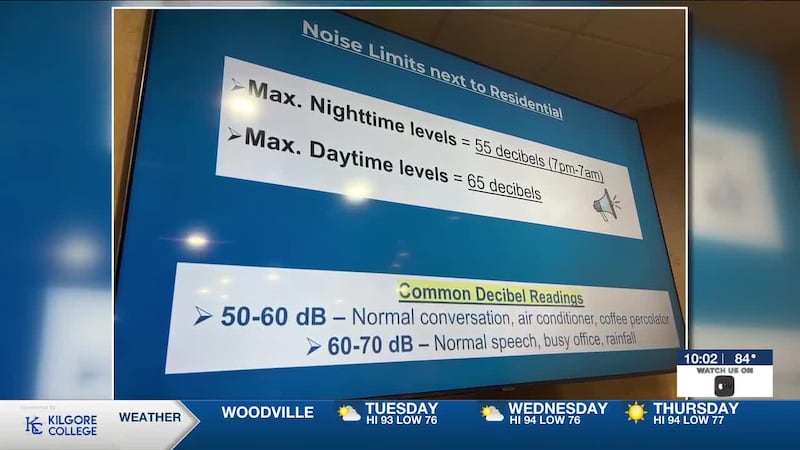
Noise near residential areas would be capped at 55 decibels during the day and 65 decibels at night, measured at the residential property line.
Helton said 50 to 60 decibels is roughly equivalent to normal conversation or an air conditioning unit, while 60 to 70 decibels is roughly equivalent to a busy office or rainfall.
The ordinance would also require that all equipment comply with state standards and that there be no detectable smoke, dust or noxious gases when detected at the residential property line.
Resident raises concerns about data centers
Resident Tom Darmstadter II said the ordinance does not go far enough, particularly with AI data centers eyeing Lufkin.
He questioned where data centers fall in the schedule of uses and raised concerns about backup generators, noise measurements and tree preservation.
“The generator situation, why are we allowing generators to be, they should be further away from residential than we’re not talking about that. So that would be the number one thing,” Darmstadter said.
He said the city should provide stronger incentives for developers to preserve existing trees rather than allowing them to plant shrubs that will reach 6 feet at maturity.
“When you have trees that are 80 to 100 foot tall that are lush and there’s understory that is there today, y’all should have some incentives for these people to keep that there,” Darmstadter said.
Darmstadter also said the ordinance addresses DBA noise measurements but not DBC measurements, which he said are needed to address hum and vibration from data centers.
“I look at this as being very reactive. And what I would love for y’all to do is come up with some stuff that is proactive. And right now on our door with the data centers, hum is the number one thing that is that’s being talked about. This isn’t being talked about at all. The C-weighted DBC is not being talked about. The vibration standard, the cooling towers that are going to be needed. Why isn’t there a certain setback from them?” Darmstadter said.
He also raised concerns about water usage disclosure and odor standards, citing odor from an existing facility on Frank Street.
Darmstadter suggested the city set up an escrow account to hire independent experts rather than relying on developers’ experts.
Staff responds to concerns
Helton said data centers would fall under a category in the permitted land use schedule that reads “any manufacturer or industrial process not listed and not prohibited by law.”
“This land use is listed in heavy manufacturing by right and then light manufacturing with a specific use permit. Those are the only districts that that would be allowed in,” Helton said.
She said staff did not find it necessary to add another land use definition because data centers would fall under that category, but the commission could include a definition in the recommendation moving forward.
Helton said the landscaping ordinance is designed to recommend preservation versus planting new.
“We actually have incentives for preserving undisturbed area and you get credit for that. And we also provide credits for preserving existing trees versus planting new. So, if you preserve existing trees, the larger the tree you preserve, the more credit that you get. And so it is set up to incentivize preserving existing landscaping versus planting new,” Helton said.
She said the ordinance includes an exception for landscape buffers located next to a creek or FEMA-designated flood plain that the planning and zoning commission could approve if existing vegetation meets the 6-foot height requirement for year-round screening.
Helton said water use is not in the purview of the zoning ordinance. She said state local government code does not allow the zoning ordinance to regulate water use, which falls under the subdivision ordinance.
For generators, Helton said the proposed ordinance includes screening enclosures and a provision that allows the city planner to impose conditions to minimize mechanically generated noise and ensure compatibility with surrounding land uses.
She said the commission could propose including setbacks for that type of equipment in its recommendation.
Helton said the ordinance includes octave band ranges, which are sound pressure levels that different decibel levels have different maximums within that octave band range.
She said the ordinance addresses odor through a provision on smoke and emission that includes noxious or toxic gases.
Commission amends ordinance
Planning and Zoning member Nathan Gann pushed to extend setback rules beyond buildings to mechanical equipment as well. The commission agreed, unanimously amending the ordinance before recommending it to city council.
Planning and Zoning Chairman Joseph Ceasar said the ordinance is a major step forward.
“While it may not be perfect, it is definitely three steps forward. So, thank you for all the work that you also do,” Ceasar said.
The changes would apply to new development and expansions of existing structures of 10% or more. Existing uses and structures would be treated as legal non-conforming, meaning they can continue to operate.
City staff drafted the ordinance based on feedback from a community workshop held in May.
Lufkin City Council will review it on July 21. The second reading and final ordinance adoption is scheduled for Aug. 4.
Copyright 2026 KLTV. All rights reserved.